Showing posts with label Analysis. Show all posts

Saturday, March 22, 2008

A Portrait of the Artist as a Young Man Explication

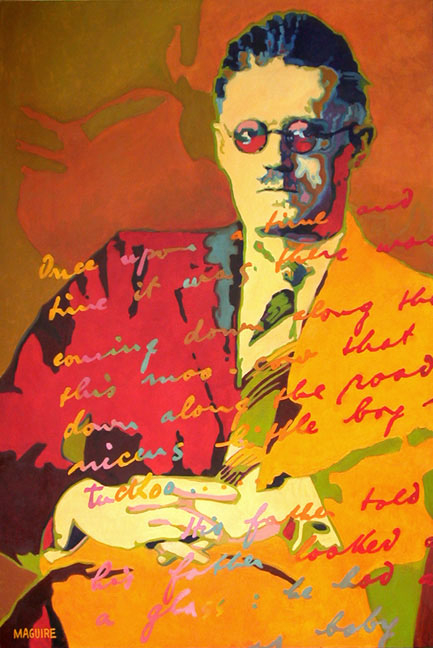
James Joyce

Stephen’s Flight from Women; A New Beginning
February 6, 2008

In A Portrait of the Artist as a Young Man, women pose a threat to Stephen’s bildungsroman as they try to control Stephen by providing physical pleasure that men naturally seek. Feminist Dorothy Dinnerstein explains in The Mermaid and the Minotaur, that it is a woman who serves as “every infant’s first love, first witness and first boss… the initial experience of dependence” (318). By nature, men are attracted to woman for their warmth and comfort, but as Stephen gets closer to his mother, Dante, the prostitute, or the Virgin Mary, they weaken him, stripping him away from his masculinity. James Joyce uses the imagery of the womb to demonstrate Stephen’s vulnerability for the “maternal flesh”. However, it is also the experience with the maternal flesh that helps him realize the need to break away from the shackles of women in order to become an artist. Because Stephen can’t physically give birth like a woman, he learns that he can create art and actually have control over his life.

Starting at an adolescent age, Stephen quickly learns that women only exist to threaten him. In the first Chapter, Stephen tells his mother that he hopes to marry Eileen when he grows up, but this is highly unacceptable for Dante. As the Catholic governess of the Dedalus children, Dante plays a mother-like role over Stephen. Dante would “give him a cachou every time he brought her a piece of tissue paper” (21) as if she is training him and teaching him to become what she wants him to become. She places control over young Dedalus. Her actions are manipulative like an adult trying to win over a child by giving him or her candy. Because she holds such strong religious values, she has already planned for Stephen to become Catholic like her. Dante refuses to have Stephen marry a Protestant girl and scolds him for such unconventional thoughts. To cleanse Stephen’s foolish thoughts, she threatens him to “apologise” (21) or else “the eagles will come and pull out his eyes” (21). His mother, being the closest person that he knows, doesn’t support him, but instead she sides with Dante and makes him apologize. Having to apologize to a woman is taking away his masculinity because men are supposed to be right at all times and never wrong. It is degrading for a man to apologize and it represents weakness. Stephen shows that he is affected as he chants “pull out his eyes, apologise, apologise, pull out his eyes.” (21). The graphical images of someone pulling out his eyes threaten him.

Even though his mother may have threatened him with Dante, it is also in human nature that men were born needing to be nurtured and loved. When a baby is born, the first thing the baby does is cry because he or she is scared and it is the holding or feeding of the mother that brings warmth to the baby. It calms the child down. Because babies are so adaptive to their mother, Stephen has trouble casting away from his mother. Even when babies grow up, they usually look for someone who posses the same nurturing methods as their mother. Stephen hoping to marry Eileen is just another “screen for a deeper love for [his] mother” (Cixous 281). Stephen’s intentions were just to play the role of a father and to be able to have someone to love and to be loved.

Because Stephen “sees his mother as a powerful and beneficent source of physical pleasure” (318), he becomes very dependent for her care and protection. Without his mother, Stephen can’t connect with any one else. Upon his entering of college, Stephen witnesses for the first time the hostile world. He feels extremely uncomfortable at Clongowes, where his parents left him. Stephen stands “on the fringe of his line, out of sight of his prefect” (21) and only wants to remain “out of reach” (21). It is as if Stephen had just been released from a womb and he was the baby. He feels “weak” (21) and “small” (21) and “his eyes are weak and watery” (21). When babies first come out, they share the same feelings that Stephen is getting. Stephen appears childlike, young, and in need of his mother. He has no options, but to stay there. “Like a heavy bird” (21), he was trapped within the school and couldn’t escape with all the heavy weight from people around him. The mother and Dante’s religious thoughts keeps him from being free.

Unprepared for a “world of social Darwinism where only the ruthless survive” (320), Stephen feels socially isolated from his new environment. He struggles to fit in with the pugnacious boys in the school like Heron or Wells. He feels different from them. Vincent Heron, an old school friend, resembles of a bird with “a bird’s face as well as a bird’s name” (78). His bird like qualities triggers Stephen’s earlier years when Dante threatened Stephen to apologize. The idea of losing his eyes marks the image of castration, unmanning him or becoming more feminine. Heron teases Stephen for being unmanly and this confuses him. Because Stephen does not smoke, Heron satirizes him by calling him a “model youth” (78) who “doesn’t smoke… doesn’t go to bazaars… doesn’t flirt… and doesn’t damn anything or damn all” (78). These were things that real men do, but Stephen didn’t like any of those things. Instead, Stephen enjoyed thinking about or looking at pretty flowers and colors. “He could not get out the answers for the sum, but it did not matter. Whites roses and red roses: those were beautiful colors to think of” (25). Inside of Stephen, his inner soul was the “anima, the feminine aspect of the psyche” (328). Stephen’s character is more feminine compared to the other boys and this becomes unacceptable in the world of Darwinism, a world of masculinity, because only the strongest can survive. Stephen feels small, frail, and like an outsider, making him lonely and emotional. Stephen doesn’t know what to do with his differences, but to just let them pick on him.

Wells also bullies Stephen for his feminine behaviors. He asks Stephen if he has kissed his mother goodnight and Stephen says yes. Wells begins taunting him for such action because in the male society, men are not supposed to kiss their mothers. Slowly, Stephen looses his masculinity and becomes more feminine. Then Wells decides to shoulder him into the square ditch where Stephen gets drenched in urine. The water is “cold and slimy” (23). Stephen “shivered and longed to cry” (23). The imagery of the cold ditch is similar to a womb. When babies leave their womb, they also feel wet, cold, and slimy. Stephen is now returning back to his womb where he can hide and escape from the hostile situation, but it is unmanning him because the idea of him wanting to hide in his mother is showing that he can’t defend for himself. He even thinks of his mother immediately after being bullied and falling into the ditch. “He longed to be at home and lay his head on his mother’s lap” (25-26). He imagines his mother sitting at the fire with “her feet on the fender and her jewelly slippers” (24). Stephen searches for comfort through imagination and thinks about her mother’s feet. Her feet provide him with something to connect with physically so he wouldn’t feel so isolated. However, Stephen appears to be very dependent of his mother because he would think of her feet just to feel close to her. Thinking of feet is something quite degrading. Every time he is bullied and made fun of, he would think of his mother, but thinking of a woman is weakening him. Stephen can’t be independent if he’s always seeking comfort and being a baby.

Even when the parents first dropped Stephen off at Clongowes, his mother had already weakened him before entering the real world. “His mother had told him not to speak with the rough boys in the college” (22) and gave him a kiss. Instead of telling his son to make friends in the new male dominated environment that he was about to enter, the mother didn’t want him to talk with any of the rough guys. It’s as if she doesn’t want her son to become one of them, which causes him to struggle with fitting in with the rest of the boys. Stephen was already a teenager preparing to go to college yet the mother was speaking to him like he was child, telling him what he can and can not do. Being able to be friends with the guys would probably have helped Stephen. His father on the other hand, gives him “two fiveshilling pieces for pocket money” (22), something concrete and useful as opposed to his mother giving him a kiss and crying. At that moment, his mother was “not so nice” when she cried. Crying only showed Stephen vulnerability and weakness. His father tells him to “never peach on a fellow” (22) instead as a survival skill in the real world. His mother’s way of support isn’t even helping him.

Beginning to feel that his mother is “not so nice” (22), he starts to move away from his mother’s and Dante’s influence. First substituting Dante with Father Arnall, the priest, because “Father Arnall knew more than Dante” (24). He begins to see the system of male authority and discipline from Father Arnall. He considers leading a devout Catholic life, until one day Stephen commits the shameful sin of female temptation. Stephen shifts back to needing a woman for comfort again.

Stephen earns a cash prize and plans to have a nice family dinner. Stephen gets excited over the opportunity to bring his family closer, but soon he realizes that “his household returned to its usual way of life” (97). Stephen feels foolish and useless for having failed.

He saw clearly too his own futile isolation. He had not gone one step nearer the lives he has sought to approach nor bridged the restless shame and rancour that divides him from father and mother and brother and sister. He felt that he was hardly of the one blood with them but stood to them rather in the mystical kinship of fosterage, fosterchild and fosterbrother. (97)

Stephen feels once again out of place and isolated, but this time from his own family. He tried to bring his family together over dinner, but instead nothing changed after all the effort he put into it. He feels like he is not part of the family and “hardly of the one blood” (97). Stephen feels emotionally hurt by his family so his subconscious instinct which was “possessed by a magic not of himself…” (Beauvoir 150), “does not obey him” (Beauvoir 150). It leads him to envision women, “a figure that had seemed to him by day demure and innocent came towards him by night through the winding darkness of sleep” (97). Stephen can’t control it, but to return back to having female desires every time he feels weak. When he meets the prostitute, Stephen becomes emotionally and physically sucked in by her. Feminist believed that men had only one way of thinking and that Stephen’s “ambition throughout the novel [is] to deflower” (322) woman. Since Stephen has physically removed himself from his mother, naturally men feel the need to fill in the gap that is created when they are separated from their mothers. In this case, the prostitute substitutes the mother because he can’t go to his biological mother anymore after realizing that it was wrong to have sexual desires for his own mother. “The perfumed female who takes him in her arms recalls his nice-smelling mother” (325). The mother and the prostitute resemble one another in his mind. He’s starting to returns back to his child-like stages of being taken care of. “Seeing her face lifted to him in serious calm and feeling the warm calm rise” (99). He felt comfort and calm like a baby being soothed as he saw her face. She leads the boy into a womblike chamber. Stephen hides himself in the arms of the woman, allowing him to take refuge from reality. It becomes his place of peace like “he was in another world” (98). Instead of facing the brutal world, Stephen runs away from the truth and the womb serves as a shield. It’s only making him more and more useless because he’s becoming too dependent of having a woman there to comfort him that it’s holding him from his flight.

In a similar way, the Virgin Mary also serves as a way of escaping reality. After committing his sin of sexual intercourse with the prostitute, “the Virgin becomes a postcoital Madonna offering refuge from the turmoil of hormonal agitation.” (326). When Stephen closes his eyes to “surrender himself to her [the prostitute]”(99), it resembles the surrender of a Christian to the Holy Spirit. He is using the church to make himself feel better by confessing his sins similar to the way he is using the prostitute to comfort him by imaging that he is in a womb. Having sinned, soon Stephen dedicates his life to self-discipline and control through daily prayers. It helps him mature as it restricts him from the thoughts of whores and virgins. However, he realizes that religion was not necessarily making him a better person because religion was only holding him back. He questions himself “I have amended my life, have I not?” (140). Stephen questioning himself demonstrates a slight change in his level of maturity. If he were to become a true Catholic, he would have to bear a boring life in the church. Stephen is unsure of himself and is having doubt, but now he actually has opinions over how he wants to live his life. Before he would only follow the words of others, particularly woman, thinking that they were always right.

Women so far have existed in Stephen’s life as sexual desires and physical pleasure, but after having sinned and feeling guilt, Stephen learns a lesson. He learns to grow out of having a woman there for him in order to feel safe. As he meets the beautiful seabird girl, he sees her in a more mature way. From afar, the woman appears as an “angel of moral youth and beauty” (156). Stephen only sees her as a work of art, something beautiful, and it demonstrates Stephen’s maturity and flight from woman. He doesn’t feel sexual attractions to her, but only hope to freeze life in a sacrament of art because “the aspiring poet knows that he may look but not touch, admire but not speak” (329). Stephen is in control now. Although Stephen is still being guided by woman, he now has a new found respect for them and a different kind of influence. He used to allow his mother and Dante to control him and he would describe the prostitute as something dirty, putting her down for making him sin. Now women exist as sacred temples of earthly beauty. Stephen becomes more attached with his artistic side. The seabird girl also represents freedom to Stephen as it symbolically represents the Myth of Dedalus and Icarus. The girl appears to him angelic and pure as she rises from the sea. It reminds Stephen that he can also live a happily life. “To live, to err, to fall, to triumph, to recreate life out of life!” (136). Even with all the ups and downs that Stephen had to experience, the falls and the triumphs, Stephen can still “recreate life out of life”(139), symbolizing his rebirth. Deciding to turn away from his mother and religion would only open up better opportunities for him.

Because of all the experiences and mistakes that Stephen has been through or committed, Stephen learns that he can be independent. The different influential women have shaped his life from being the young and baby-like Stephen to the more mature and artistic Stephen. He learns that the women in his life only serve as matriarchal threats because they are all taking away his masculinity by trying to control every aspect of his life and making him dependent of them. However, Stephen needs the experiences because with out ever feeling vulnerable, one can not grow successfully. One must needs to know what is wrong before they know what is right. Stephen has evolved from his younger years through the experience of temptation and then sinning. It made him feel guilty and this led to him going to church. Then Stephen realizes that the life of devotion and obedience did not suit him and instead he frees himself by leading a life on his own. At the end, Stephen leaves all that he has. He leaves his mother, religion, his home land, and this allows him to be the true artist that he is.

Friday, March 21, 2008

Tom Phillips’ A Humument Explication 02.25.08

On page 104 of Tom Phillips’ A Humument, Phillip suggests that imagination is a beautiful art form allowing one to create an endless number of masterpieces. However, with this ability to create comes insanity. Like “alcohol”, the art of imagination intoxicates the mind causing reality to fade.

In viewing the page, a wide range of colors make up the piece. The colors are formed in a blotchy manner with no particular shape, size, or pattern. In one way it resembles an ink blot, allowing the viewer to conceive it in any way possible like a work of art that is open up for interpretation. In another, the colors represent imagination. There are no limits to the colors like there are no limits to the wonders of imagining. The colors evoke different emotions and it allows the viewer to interpret the different colors according to his or her own imagination.

The colors appear to be separated into a top and a bottom where the top uses darker shades of color as oppose to the bottom where lighter shades are used. The lighter colors suggest a sense of innocence in believing the imaginary. Often times children are the ones who play pretend and it seems innocent in the eyes of a child because it shows that they too can hold ideas, creativity, and “character”. In another view it is an innocent game that humans seek to escape from the brutal world. Imagination opens up opportunity to be “quite a different person (in) quite a different cause”. It’s interesting how the word “person” is camouflaged in manila color against the light orange blots. In the art of imagination, there is no true identity because identity can be changed and altered to anyone and anything. Instead, the true self is hidden and covered, but at the same time it is still there and visible. Being able to imagine gives the mind the ability to fabricate different reasons and causes to why things occur which is why imagination is beautiful and rich.

There are no limits to what one can be if one conceives imagination. It’s even possible to “character a sound”. The color pink circulates the phrase. Pink symbolizes hope and playfulness. It’s joyful and merry like the art of imagination because anything can be possible. Sounds can be characters. Characters can be sounds. The number of ideas is unlimited. It is something “beautiful”, but at the same time when a person makes believe of a person, place, or thing, it becomes “beautiful as well as nonsense” in the eyes of others. The idea of what is real is questioned.

The dark shades of red and purple suggest a negative perspective of the imaginary world. On the top, Phillip introduces the idea of pretending. He writes, “I feel somehow as if we were playing at ‘pretending’ now”. Pretending is a form of imagination where one makes believe or performs fictitious play. However, it seems nonsensical to be playing at pretending when pretending is already a way of playing. The art of pretending seems to have lost its charm on Phillip. His thoughts are graphical and his imagination is filled with “thoughts of the blood like alcohol”. It symbolizes the idea of intoxication where pretending has become an addiction. It’s no longer a fun innocent game, but like “a fresh packet” he seeks it like drugs. The colors red, purple, and blue circle the negative text. They are all very bold and vibrant colors that draw in attention, but together the colors are heavy and burdensome. It’s suffocating to look at when the colors conflict one another. Together the colors mark insanity.

Phillip appears to have lost his sanity as he strives deeper into the imaginary world. He writes “I was picture of him dyed and curly”. The word “dyed” puns for the word “died”. The image of a dead person bothers Phillip. It is the only complete sentence that he has circled and it is the only time in which he addresses himself and his feelings ever since the first line. Around the thought are pen marks that attract attention. The markings are stroked deeply and dark as if he is angry and mad. It is also the only text that is colored by the paint, signifying its significance. The text represents the imagination that he has created. Instead of fantasizing mirthful memories or ideal thoughts, the image of a dead man appears and this haunts him. The black markings signify fear and agony. It can also signify his confusion as he is unable to decide what is real.

Although it is difficult to define what is real and what is considered the imagination, Phillip nevertheless shows the beauty of the art through his splash of colors. However with the power to control in the imaginary world, it questions the idea of reality. Imagination starts to become the truth as reality shifts to a blur. Ultimately, it leads to harming the mind.

Plum Plum Pickers Explication 11.15.07


In The Plum Plum Pickers, Raymond Barrio reveals his meaning of being human, particularly a man, in which one is not alive unless he or she surpasses oppression and self-degradation because it only holds him or her back from achieving the true honor and pride in being human. Barrio’s emphasizes on this state of being oppressed through his use of various short and detached sentence structures and the imagery of animals and machine to create the effect and allusion of a trapped nonhuman character in the first page of the story. However, by the climax, Manuel discovers a way to hinder oppression. Barrio then makes a subtle transition from the short and detached sentences to the long complete sentences and to the imagery of a unit. Manuel becomes a “man” of ideas and power, freeing him from oppression, and allowing him to be a human.

Manuel, the protagonist of the story, is a farm worker who works for hours and hours manually picking fruits. Immediately, the story reveals a sense of how Manuel views his life as he compares the farm to “an endless maze… like the blackest bars on the jails of hell”. Ultimately, he does not enjoy his life because his life is pretty much enclosed and jailed. He does not see his job as great fun, but rather like torture. Manuel appears to be in this morbid state where he‘s struggling for “living moisture” and pleading for a way out for “there had to be a way out” much like a man in jail who is “trapped”. Then these one word sentences start to appear and it’s as if these words are randomly popping into Manuel’s head. They’re like short moments of consciousness for Manuel and also words that describe him like “Beast” or “Brute”, all adjectives or nouns with a negative impression, making him seem filthy and caveman-like. The usage of short sentences also establishes time. The word “Lunch” is placed in its own paragraph that the time period of lunch seems so short. Before, there was a long description of his day, but then “Lunch” is only said in one single detached word that it almost appears insignificant to the story. The time to eat for Manuel is like a 4 seconds break and then its back to the endless work and “the endlessly unending piling up of bucket upon box upon crate upon stack upon rack upon mound upon mountain”. By making this long sentences constantly repeats the word “upon”, it creates the feel of an unending surplus of work burdening him from doing anything else.

Not only is Manuel oppressed by the setting of the farm and the work, but also in every time that he comes close to describing himself and telling more. Short phrases would cut him off from the story. Phrases like “The trees. The branches again…The ladder”. All these phrases are not even important to the story nor are there any verbs involved, yet they are able to over power Manuel’s significance in the story. Unable to do anything about his life, Manuel becomes even more oppressed as “he was too tired even to curse” when Roberto took order over him. Spiritually and emotionally, Manuel demonstrates carelessness and a lack of motivation to be living or be human as it repetitively describes him as being “tired” and “exhausted”. He’s “truly a refined wreck of an animal”. Manuel is clearly like an animal in the story, one who resembles a lazy pig and a “predator” because he’s easily bullied by Roberto, “the cannibal”, and by men of higher status. Once again, another one sentence paragraph, “Mid afternoon” appears. The movements of time passes by him ever so suddenly again and the process continues with a pattern of big paragraph, one sentence paragraph, etc for rest of the first page of the story. The paragraphs are so composed and structured that in an overview, the structure looks a bit robotic and mechanical like Manuel himself. His life is basically work, lunch, work, afternoon, work, and end. He’s like this machine that is programmed to do that amount of work each day.

However, when the day “Ended!”, everything negative of Manuel also ended. Instead, he becomes this totally different man with an unexpected aura of confidence where he had to “keep his temper from flaring.” Manuel never seemed to care much for Roberto Morales before when he yelled at him, but Manuel was definitely changing. Now all the pickers “gasped as one”. In the beginning of the story, it focused mainly on himself or on only one person, but now there is this imagery of pride. When people do things together, they share something in common and it shows unity among them. This unity in humans was not seen in the beginning, but rather Manuel “felt alone though surrounded by other pickers”. The sentence structure now is also different from before. Rather than having pure 3rd person perspective of the story. There is now dialogue and long detailed sentences. Manuel is depicted much more as a human now. He speaks and he is concise in establishing what is right and wrong. In kicking the second bucket, the fruits roll “in all direction” as if opening new paths for Manuel to take.

Through taking risk to break free from oppression of the world, Manuel is able to discover that men are built to count for something and to experience honor and pride; likewise to Robert Barrio’s meaning of being human. Successfully, Barrio was able to depict the feeling of being deeply oppressed by the surrounding to the point of nonexistence because if one continues to conform to what is wrong for “hour upon hour”, it will become “decades upon decades“ and life would just be as if he or she is “dead before they die.”

Explication on Albert Camus’ The Stranger 10.1.07


Absurdity

Although it is unclear whether life has meaning or not, society nevertheless desires to manufacture meaning behind existence much like the society portrayed in Albert Camus’s The Stranger. Camus’s portrayal of Meursault ultimately defines a lost soul, a man who embodies no emotions and no rational order. His indifference separates him from the society where everything that happens must have reasons and explanations. Unlike society, Meursault reflects on the title “The Stranger” in which one identifies as a foreigner within his own society because he doesn’t care for what he believes he can not control, which is his life. As humanity attempts to build and impose meaning on Meursault in the preceding of the trial and before he is sentenced to death, Albert Camus projects what he calls the Absurd where others have the authority over his life when he doesn’t.

Before the preliminary of the trial, the two policemen place Meursault in a small room where he hears “voices, shouts, chairs being dragged across the floor” (82). Meursault appears to have no fear toward anything even though he is about to go into trial. Instead, he thought about “neighborhood fetes” and was well interested into seeing the trial. Meursault isn’t really taking his trial seriously because he pokes fun at the screeching noises. Most people would be in fear before a trial especially after hearing such uproar, but Meursault takes in the piercing sound and compares it with happy cheers from parties like he’s having the best time of his life. It exemplifies the carelessness that Meursault has for his life. As the preliminary trial begins, Meursault’s persona begins to unfold from being careless to actually having feelings and emotions in life. He spots “the sun filtered through in places” (83). It felt like the sun was projecting a sense of hope and discovery like light and goodness still existed and it was entering. There was an imagery of god sending him a message and that there was still hope for Meursault to hold onto his life.

Then Meursault notices “a row of faces in front” (83) of him. Camus uses the court scene to symbolize society as a “whole” which Meursault describes that there was nothing to “distinguish one from another” (83). At this point, everyone is looking at him as if they are there to judge him. He “hadn’t realized that all those people were crowding in to see” (83) him, but now he’s at center stage between all the people and it is him versus society. Meursault is in constant conflict with society because his life exceeds beyond his control. The lawyers, juries, and witnesses now have the power to determine his fate. Meursault had been advised to “respond briefly to the questions” (85) and to “leave the rest to him (his lawyer)” (85). Unable to have any word on his own trial, his life is in the hands of others which is ultimately absurd because the witnesses are given the right to determine his life. As a result, the prosecutor makes false assumptions to the case, using non relevant information concerning his reaction on the day of his mother’s death to support what is undefined and what Meursault believes to be plain “bad luck”(92). The trial depicts nothing more than a “perfect reflection of… everything is true and nothing is true!” (91) The prosecutor never achieved a reason for why he shot the Arab, but improvised his own reason. Even without solid proof, the jury finds him guilty. His life was basically determined by people like Thomas Perez, who he met only for one day.

When the father speaks to Meursault concerning religion, it portrays a similar authoritarian over Meursault as the trial. The father insists “God can help you, every man in your position has turned to him,” (116). Society appears to constantly bring in meaning toward every aspect of life. They consider bringing in a priest so before one dies, they could realize the importance of their existence. Normally people want to seek god to rid their sins before dying. However, Christianity is just another rational belief in attempt to find meaning and order in life by basing it on God’s creation. Truthful to his beliefs and atheism, Meursault refuses to allow the father have religious authority over him because he believes that life is meaningless. Living was pointless for “we were all condemned to die” (117). It appears illogical to believe in God when God takes away life. If one is to believe in god, their only applying a fake proof into why certain rational events occur when most of the time; it’s just the way it is and there is no meaning.

The father questions why Meursault does not call him “father.” Meursault actually takes calling him father quite literally because he thinks father as calling him his real father when the priest meant to call him in a holy way and giving him stature. However, Meursault can only derive the literal meaning of father because of his irrationality. Most importantly, the priest has the ability to question Meursault’s beliefs as he pops questions concerning faith, “Have you no hope at all? And do you really live with the thought that when you die, you die, and nothing remains?” (117). As much as Meursault didn’t like it, the priest achieved power and authority over him by making Meursault think and reflect upon himself, igniting the first fire and an outburst of emotions.

Throughout the novel, Meursault believed that life by existentialism had no meaning or purpose. Without any concern or regards to finding a rational structure, his life was pretty much predetermined not only by fate but by those who afflicted his voice: the jury, lawyer, prosecutor, and the priest. Other people have more power and influence on his life that he did and that was what created the absurdity in the novel. It is not until the end when he’s in jail that Meursault grasps onto his life. Although humans have unchangeable destined fates, he realizes that he can control his emotions. Whether to morn and scream for help or to live the last day of his life like treasure was now his preference and his control. If Meursault had never realized his faults and gained an understanding of his absurd world, he wouldn’t have been able to experience a fulfilling happiness.